A giant star is changing before our eyes and astronomers are watching in real time
February 6, 2026 – 12:05 PM
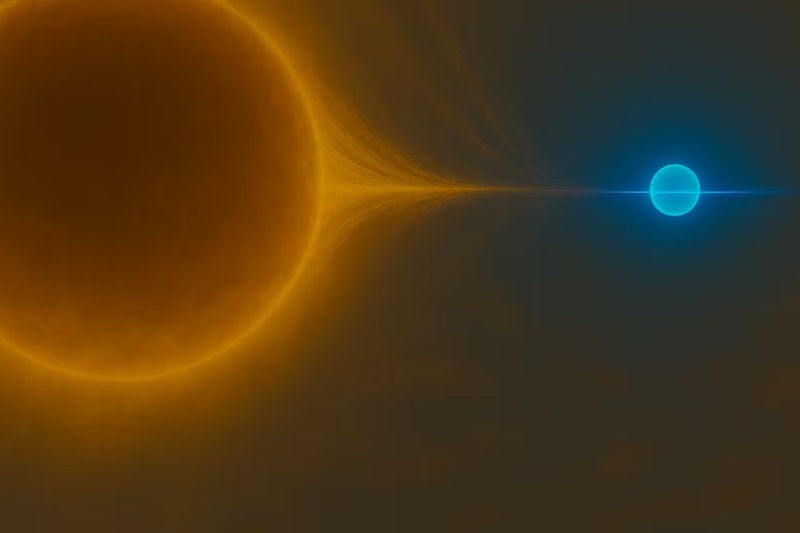
The red supergiant with its suspected smaller, hotter twin living alongside it. (SALT via The Conversation)
How logistics industry experts plan to ‘move forward’ after COVID-19
Reasons why Filipinos love Korean culture and products
Why Batangas is the destination for budget-friendly family holidays
For decades, astronomers have been watching WOH G64, an enormous heavyweight star in the Large Magellanic Cloud, a galaxy visible with the naked eye from the Southern Hemisphere. This star is more than 1,500 times larger than
the Sun
Astronomers didn’t think its final demise would happen anytime soon, because no-one has ever seen a known red supergiant die. But in recent years astronomers – including our team working with the
Southern African Large Telescope (SALT)
– discovered that this star has started to change, growing dimmer than before and seemingly warmer. This has surprised scientists and suggests the star’s final stages of life may be more complicated, and perhaps unfold faster, than once thought.
Massive stars, more than about eight times the mass of the Sun, produce so much energy, which we see as light, that they run out of fuel within millions of years, instead of the billions of years of the Sun’s lifespan.
In the 1960s Swedish astronomers Westerlund, Olander and Hedin
discovered
InfraRed Astronomical Satellite
Then, in 2024, our team (both authors of this article and our collaborators in Germany and the US) succeeded in taking a close-up image of WOH G64 using the European Southern Observatory’s telescopes and revealed a fresh cloud of dust close to the star. It was the sharpest picture of a star in another galaxy ever taken (comparable to being able to spot an astronaut walk on the Moon from Earth). We discovered that in the last decade, unexpectedly, the star had started to eject much more dust than before. At that time, we did not have an idea about why and how.
It turns out, WOH G64 had also become dimmer, possibly because of the dust cloud it had ejected, and started to pulsate less and a little more quickly, suggesting it had shrunk. At the same time, the star seemed to look a lot warmer, leading some to believe it might have entered a new stage of its life – a so-called yellow hypergiant on its final path to doom.
All these phenomena are happening on a human time scale, which is usually not the case when we observe stars. This makes WOH G64 even more special. Is this star offering us an opportunity not to be missed to witness the final death throes of massive stars?
Now, as we start 2026, we have
announced
that observations we have obtained using the
Southern African Large Telescope
For a long time, astronomers have suspected that the red supergiant has a smaller, hotter twin living alongside it, but they have somehow been reluctant to claim this in publications. And now it looks to be the elephant in the room. One way of making sense of our observations is that this hotter star, looking blue in contrast to its bigger, cooler, red sibling, heats gas it might have captured from the red supergiant’s wind. Now that the red supergiant has faded, the presence of the heated gas has just become more conspicuous.
If the orbit of the blue star is not a circle but quite elongated (Earth’s orbit around the Sun only slightly deviates from a circle), the distance between the blue star and the red supergiant varies. It may have got closer in recent years, and its gravity might have caused the atmosphere of the red supergiant to stretch out. This would make it more transparent overall, allowing us to see the warmer interior, but with cool, dark molecular patches left in places. That would also have made it easier for dust to form further out in its wind.
If that is true, then once the blue star starts to recede again on its orbit, WOH G64 might regain its former red supergiant glory. On the other hand, if it did throw off its coat entirely, then the molecules would disappear, and with it, the dust, and we would gain a clean view of the star. Then again, WOH G64 might do something else unexpected. It certainly teaches astronomers to be humble.
Keiichi Ohnaka
, Associate professor,
Universidad Andrés Bello (Chile)
Jacco van Loon
, Reader in Astrophysics,
Keele University.
The Conversation
under a Creative Commons license. Read the
original article
TAGS
Elias
Frogel
Hedin
Large Magellanic Cloud
Olander
salt
Schwering
Southern African Large Telescope
Westerlund
WOH G64