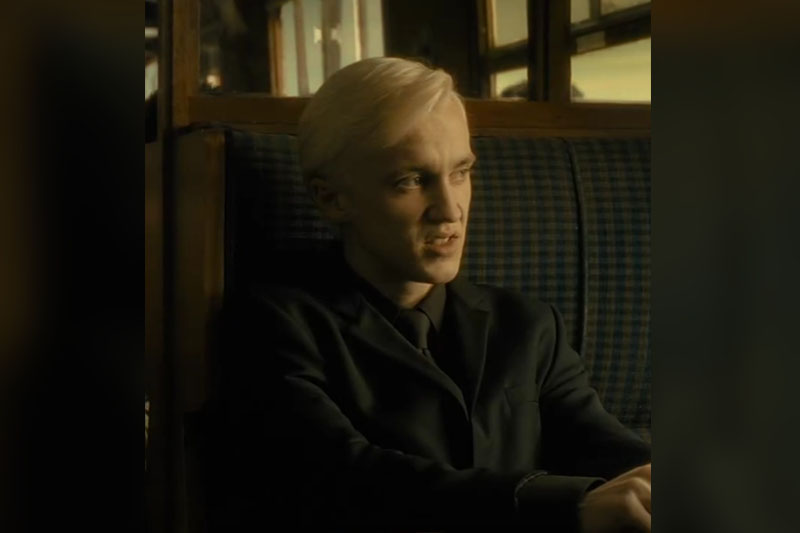
Who is the new face of China’s Year of the Fire Horse? Draco Malfoy, of course
February 17, 2026 – 12:15 PM
How logistics industry experts plan to ‘move forward’ after COVID-19
Reasons why Filipinos love Korean culture and products
Why Batangas is the destination for budget-friendly family holidays
The Chinese Year of the Fire Horse has a new, unexpected mascot: Draco Malfoy.
Associating the Harry Potter antagonist with China’s Year of the Fire Horse might seem odd or whimsical. But it has much to teach us about the complexities of Chinese Mandarin wordplay, online participation and meme-making culture.
A search for
Malfoy memes
manifest his youthful head floating jubilantly, amid a background of red, gold and black calligraphy.
Meaning in images
Classic
New Year prints
Prior to the annual festival, the Chinese character
fu 福
This is because the word for “upside-down” (倒, dao) is word play on the word “arrive” (到, dao) in Mandarin. Hanging the fu 福 upside down means “Good fortune has arrived”.
During last year’s
Year of the Snake
wordplay used
snake (蛇, shé) and earthly beings/humans (巳, sì) to pair snake imagery with phrases about time, events or letting go.
This
Year of the Fire Horse
is historically linked with energy, momentum and breakthrough.
In this way, Malfoy sheds his snake skin from villain to a serendipitous linguistic fit for a year defined by fiery horses and potential prosperity: a modern good luck poster.
Visual remixing
Humor, wordplay and visual remixing are a key feature of Chinese internet culture.
easily remixed
. Malfoy’s titanium white hair and sharp features make him iconic, even in small or edited images.
Another example of homophonic wordplay was during the
#MeToo
movement.
Facing political sensitivity in China, activists embraced phonetic wordplay to
visualise the phrase #MeToo
, juxtaposing images of a bowl of rice (米饭, mi fan) with a rabbit (兔子, tuzi). The Chinese meme, Mi Tu (literally rice bunny) is visually coded “cute” on the surface, yet functions with the potency and strategic agility of a Trojan Horse.
The memes became a political statement, to visually disrupt and address sexual abuse or harassment.
The Grass Mud Horse (草泥马, cǎonímǎ) is a mythological alpaca co-created in 2009 as a linguistic and visual protest symbol.
Its name is a homophone for a well known insult, enabling users to express defiance while circumventing censorship. It became a playful yet powerful
emblem of resistance
to information control, widely circulated through
music videos
, memes and satirical narratives.
The homophonic wordplay of Draco Malfoy performs a similar cultural function — with celebration that evolves tradition, rather than political protest. Users paste
Malfoy’s face
onto fire horse emojis, Chinese calligraphy or zodiac themed layouts. Others animate him riding red horses or link his image with auspicious greetings.
Culturally specific memes
Visual culture is culturally specific
: meaning cannot be transported across contexts without interpretive friction.
Chinese culture has a long history of playful symbolism. The Malfoy memes fit into that tradition using humour and visual puns to express good wishes. It does not replace sacred rituals or religious practices.
It is about renewing hope for the future, and memes are a clever example of how language shapes visual culture and how traditions evolve.
Visual literacy enables us to unlock the cultural keys embedded within symbols and myths, revealing layers of meaning that might otherwise remain obscured.
Online spaces are where a fictional wizard can temporarily join a centuries-old symbolic system built on flexible wordplay and visual humour for the Year of the Fire Horse.
Justine Poplin
, Teaching Associate, Faculty of Education,
Southern Cross University.
The Conversation
under a Creative Commons license. Read the
original article
TAGS
china
Chinese
chinese new year
Chinese New Year 2026
CNY 2026
Draco Malfoy
harry potter
internet culture
Lunar New Year
Lunar New Year 2026
memes
social media