From banana leaves to better livelihoods: How a Filipino innovator is turning waste into work
January 2, 2026 – 5:36 PM
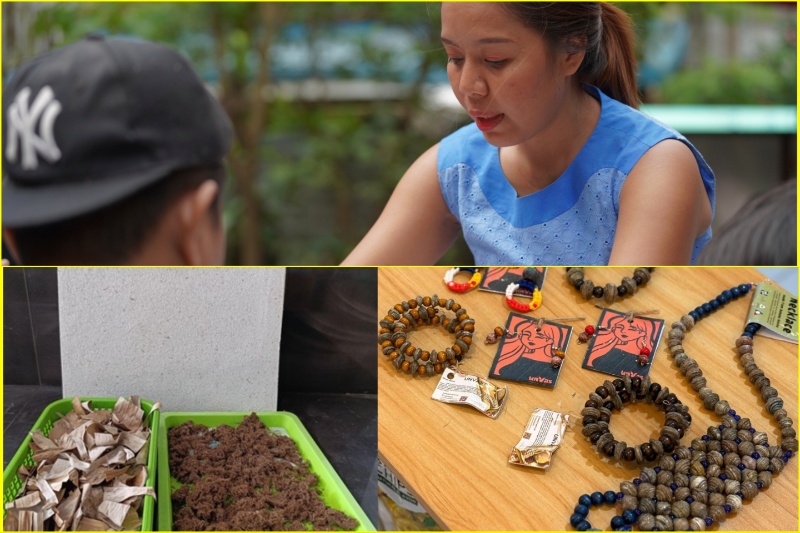
This composite photo shows Julienne Stephanie Fabie-Agapin and Unas Canvas (UnVas) crafts. (Heherson Valdez via DOST)
How logistics industry experts plan to ‘move forward’ after COVID-19
Reasons why Filipinos love Korean culture and products
Why Batangas is the destination for budget-friendly family holidays
As the Philippines continues to grapple with the challenge of creating sustainable jobs, the numbers tell a sobering story.
Data from the
Philippine Statistics Authority r
eleased last November 6 showed the country’s unemployment rate at 3.8% in September 2025, slightly higher than the 3.7% recorded in the same month a year earlier. Behind that percentage are 1.96 million unemployed Filipinos.
Julienne Stephanie Fabie-Agapin
, a chemist and innovator from the University of the Philippines Visayas, that challenge became a call to action.
Dried banana leaves
Unas Canvas,
UnVas
, did not begin as a polished research proposal or a laboratory breakthrough. Instead, it started with a conversation in 2021. At the time, Fabie-Agapin was serving as an associate professor at
Western Mindanao State University (WMSU)–Pagadian
and leading a
Department of Science and Technology (DOST)
-funded project on bioplastics derived from agricultural waste. She was also working with persons deprived of liberty (PDLs) on handmade paper-making as a livelihood initiative.
That year,
Jimmy Sorabia
, chairperson of a cooperative composed of displaced overseas Filipino workers (OFWs), approached DOST in search of livelihood support for his group. He was referred to Fabie-Agapin, and with the referral came a challenge: Could dried banana leaves be turned into something marketable?
In many farming communities, dried banana leaves, or unas, are treated as waste. They are often burned or left to decompose, processes that release harmful chemicals into the environment. Fabie-Agapin saw something different: an abundant, underutilized material with untapped potential.
“The usual thing they do is burn the dried banana leaves or let them degrade on their own,” Fabie-Agapin explained.
“With our initiative, instead of burning them, we were able to upcycle them into a material that becomes a source of income for our partner communities,” she added.
Livelihood
Beyond the science, the true impact of UnVas is felt in the communities that now produce it. During the UnVas Community-Based Production Training held at the
Gumamela Neighborhood Association Housing Cooperative (GNAHC)
on Nov. 15–16, 2025, Fabie-Agapin witnessed how the material translated into opportunity.
Senior participants, including Nanay Gloria, described the training as more than just skills development. It was, she said, “a livelihood we can proudly call our own—maganda ang quality at gawang Pilipino.”
UnVas has since empowered partner communities to create eco-friendly products that are not only sustainable but also proudly local.
From community innovation to global recognition
The journey from dried leaves to global recognition was made possible through strategic support. With assistance from
under the
Grants and Assistance to Leverage Innovations for National Growth (GALING) Program
, Fabie-Agapin was able to scale up UnVas’s
Technology Readiness Level (TRL)
and conduct initial market validation.
This support ensured that the innovation met technical standards and demonstrated commercial potential—key steps toward consistent production and workforce development in partner communities.
UnVas later stepped onto the international stage through DOST-TAPI’s
, earning a
Silver Award at the 2024 Korea International Women’s Invention Exhibition (KIWIE)
. Fabie-Agapin also joined
Cohort 3 of HIRANG 2.0
, a program designed to prepare government-funded technologies for investment and commercialization.
—Heherson Valdez
TAGS
DOST
Jimmy Sorabia
Julienne Stephanie Fabie-Agapin
Philippine Statistics Authority
Unas Canvas
UnVas