December 16, 2025 – 10:19 AM
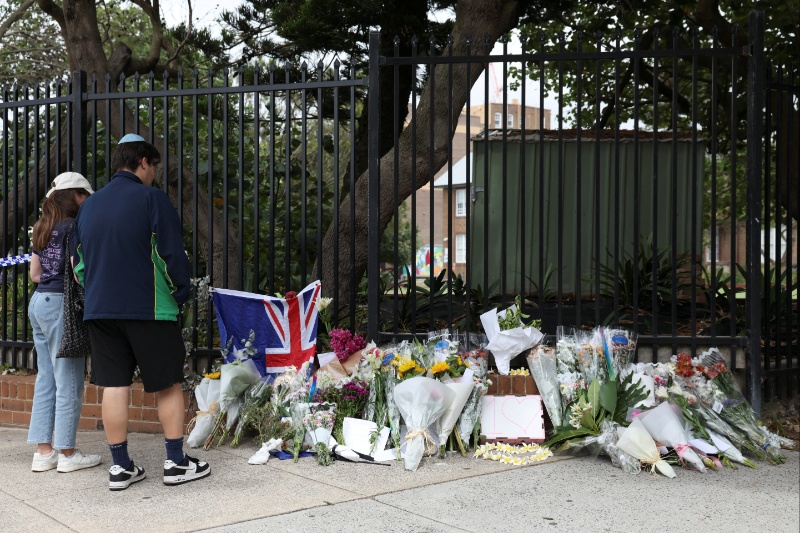
People stand next to flowers left at the scene of a shooting on a Jewish holiday celebration at Bondi Beach, in Sydney, Australia, December 15, 2025. (Reuters/Hollie Adams)
How logistics industry experts plan to ‘move forward’ after COVID-19
Reasons why Filipinos love Korean culture and products
Why Batangas is the destination for budget-friendly family holidays
Police have confirmed the two alleged attackers were
father and son
, aged 50 and 24. The father, Sajid Akram, who was licensed to own six firearms, was shot dead by police. The son, Naveed Akram, remains under police guard in hospital.
Given it was clearly an antisemitic attack, authorities soon after declared it an act of terrorism – that is, an act of politically motivated violence. This designation also gives authorities extra resources in their response and in bringing those responsible to justice.
As Australians try to process their shock and grief, there has been some anger in the community that not enough has been done to protect Jewish Australians from the rising antisemitism evident since the Hamas attack on Israel in October 2023 and the ensuing Gaza war.
What we know about the alleged attackers
ASIO (The Australian Security Intelligence Organisation) Director-General Mike Burgess
has said
one of the alleged gunmen was “known” to ASIO, though he did not specify which one. Being “known” to authorities can simply mean someone has been associated with networks and communications that have caused concern to authorities. The
ABC has reported
that Naveed Akram came to the attention of authorities after the arrest of Islamic State Sydney cell leader Isaac El Matari in July 2019.
However, there are hundreds of people who come to authorities’ attention for their contact, online or off, with extremist networks and individuals. With limited resources (and authorities’ resources will always be limited, no matter how much funding they have), they have to run a triage system to assess the threat an individual or a group may pose, and manage the risk as best they can.
They will carefully assess what is being said and the language used, for example, as well as looking at whether a person has a history of violence. As angry and upset as people understandably are in the wake of such a horrific incident, it needs to be recognised that authorities can’t simply arrest everyone who expresses extremist ideas or has passing links with extremist elements.
We still need to know more about this terror attack and the alleged attackers, but to date there has been no evidence of a network in operation. Given the alleged gunmen were father and son, this technically fits the profile of a “lone actor” attack, as we saw in the Lindt Cafe siege in 2014, and Christchurch in 2019.
As Burgess pointed out in his
annual threat assessment
, “our greatest threat remains a lone actor using an easily obtained weapon”. Sadly, that has been shown to be true.
Changing nature of terrorist threat in Australia
There has been much attention in recent years on
the rise
of far-right extremism and terrorism.
One of the best guides to this is Burgess’ annual
threat assessment
More broadly, Islamic terrorism continues to remain a global threat. IS and Al-Qaeda remain active in the Middle East and increasingly in Africa, as well as central Asia and Afghanistan. Generally, authorities are doing a good job of keeping on top of any threats these networks might pose in Australia.
There is no doubt the general atmosphere between pro-Palestinian and Jewish groups has become far more febrile in the wake of the Hamas attack and the Gaza war. There is a lot of anger and frustration as scenes of violence and suffering are broadcast daily, and we have seen a rise both in antisemitism and
Islamophobia
since the war began, simply because of the way it plays out in people’s imaginations.
But even in the protests we have seen over many months, the number of people who might use this sentiment to spur violence is small.
Again, there is no evidence the Bondi shooting was part of a wider network, and it is very difficult to stop a lone actor attack on a public site.
In a glimmer of hope, the man whose much-lauded act of heroism in wrestling one of the alleged gunman’s weapons from him has been named as 43-year-old Muslim fruit shop owner Ahmed Al-Ahmed. It is hoped this man’s bravery, which showed us the best of humanity in the midst of the worst, will stop any simplistic analysis of blaming the Muslim community for such violence. We have seen this
in the United States
, and Australia must do much better.
Has the government done enough?
It is very difficult to keep outdoor public events entirely safe: buildings are relatively easy to secure, but a park at a beach far less so.
The government clearly needs to do more to stop terrorism, and public events are an obvious focus for more resources. No one should be satisfied with where we are right now. It is simply horrifying. But it’s going to take a lot of work to figure out where we can best use resources.
We can’t close every loophole or thwart every risk. We can’t stop people turning to violence, and we can’t police every hateful thought. It has been said this was an attack on all of us, and that’s very true. As the message of Hanukkah inspires us, now is the time when we need to pull together as Australians from all faiths and communities, and work together to ensure that light triumphs over darkness.
Greg Barton
Deakin University
The Conversation
under a Creative Commons license. Read the
original article
TAGS
Bondi
Bondi Beach
Sydney