Large trunks discovered in a basement offer a window into the lives and struggles of early Filipino migrants
December 19, 2025 – 2:43 PM
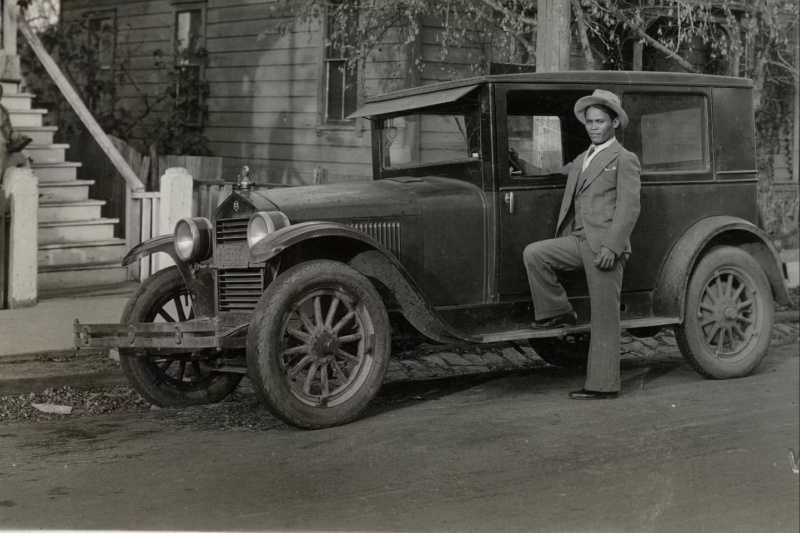
A Filipino man poses next to a Ford Model A in the 1930s.
(Filipino Agricultural Workers Collection, Archives Center, National Museum of American History via The Conversation)
How logistics industry experts plan to ‘move forward’ after COVID-19
Reasons why Filipinos love Korean culture and products
Why Batangas is the destination for budget-friendly family holidays
In 2005, Antonio Somera, a Filipino American member of the
Legionarios del Trabajo
, a Masonic fraternal order, stumbled across a trove of mysterious-looking containers while he was cleaning out the basement of the Daguhoy Lodge in Stockton, California.
The containers, which had been abandoned for decades, included more than a dozen steamer trunks – large luggage chests designed for long-distance travel – and a handful of suitcases dating to the 1910s.
They belonged to former Legionarios del Trabajo members who at some point lived in the lodge but had passed away. Fraternal brothers packed their personal belongings to memorialize the deceased and hoped that surviving family members would later reclaim the objects.
These unusual time capsules and their contents tell a largely forgotten history of the men and women who had left the Philippines in the 1910s to work in Hawaii’s sugar industry and later settled in California’s
San Joaquin Valley
. Affectionately dubbed “
Little Manila
,” south Stockton became an important hub for one of the largest communities of Filipinos outside the Philippines.
Along with my curatorial assistant, Ethan Johanson, we studied the fascinating objects and photographs found in the trunks to tell the story of this largely forgotten cohort of migrants.
Here are five objects that capture the breadth and depth of life and work in California, Hawaii and other states for Filipino migrants. They’re among those featured in an exhibition created by the Smithsonian Asian Pacific American Center on display at the Smithsonian’s National Museum of American History. Titled, “
How Can You Forget Me: Filipino American Stories
,” the exhibition explores the making of the Filipino American community in Stockton between the 1910s and 1970s.
1. The steamer trunk
A wardrobe trunk that held the personal belongings of Anastacio Atig Omandam, who left the Philippines in 1916 to work in Hawaii and later settled in Stockton, Calif., where he died in 1966.
National Museum of American History
This steamer trunk formerly belonged to Anastacio Atig Omandam, a worker who arrived in Honolulu from the Philippine province Negros Oriental in January 1916.
Omandam was part of a group of mostly young, single men who were recruited by sugar plantation companies as early as 1906 to work in
Hawaii’s booming sugar industry
After the United States defeated Spain in
the 1898 Spanish-American War
, the Philippines was
under U.S. colonial rule until 1935
Filipinos living under American rule and in U.S. territories
were designated as U.S. nationals
, an ambiguous legal status. It allowed Filipinos to migrate relatively freely within U.S. territories, but they lacked constitutional protections and privileges such as citizenship and voting rights.
They were, in essence, time capsules of each of these men’s lives.
2. An asparagus knife
An asparagus knife appears above various tools, all of which were found inside the trunks.
National Museum of American History
The large, unusual-looking metal instrument found in one trunk is a knife that farmworkers used to harvest asparagus.
During the harvesting season, typically between February and June, workers wielded this knife, using the sharp edge of the forked blade to pierce approximately 6 inches (15 centimeters) below the soil to cut the root of the asparagus.
Harvesting asparagus demanded dexterity and speed. Workers needed to constantly bend over to cut and collect the produce as they moved up and down the rows. This repetitive and backbreaking motion earned Filipino farmworkers the derogatory label “
stoop labor
After
a series of restrictive immigration laws
When the harvesting season was over, Filipino farmworkers migrated to other West Coast states to harvest apples, hops and grapes. Others
went to Alaska to can salmon
The asparagus knife was found among the containers in the basement, alongside other grafting and pruning knives. These tools – still carrying the soil from which they were tilled – represent the work of the immigrant farmworkers of all backgrounds who helped build
California’s agriculture industry
, which continues to feed the nation today.
3. Three-piece suits
Three-piece suits were found in nearly all the steamer trunks, along with Stetson hats, bow ties and other fashionable accessories from the 1920s and ’30s.
This tailored three-piece suit with matching Stetson hat was worn by Anastacio Omandam.
National Museum of American History
Despite earning meager wages, most Filipino farmworkers saved their hard-earned money to purchase at least one tailored three-piece suit. Men donned these stylish garments to attend Sunday Mass, dinners and
taxi-dance halls
– where they could pay a small fee to dance with a professional dancer – or merely to strut their stuff down the streets of Stockton’s Little Manila.
Because Americans often looked down upon agricultural workers as uncultured and illiterate – “
little brown monkeys
Not everyone was enchanted. Some white Americans viewed these slick, handsomely dressed Filipino men as a sexual threat
that could “steal” their women
4. A pageant dress
This sequined dress belonged to Barbara Nambatac, a longtime resident of Livingston, California, who grew up among the “
manongs
,” a kinship title meaning older brother often used when referring to this early generation of Filipino migrants.
Barbara Nambatac wore this white dress when she was crowned Queen of Little Manila in a 1971 beauty pageant.
Photo by Phillip R. Lee
Her Filipino father was a cook who served food to Filipino and Mexican field hands on farms throughout California’s Central Valley, where he later met Nambatac’s Mexican mother.
In the 19th century and into the 20th century,
California’s anti-miscegenation laws
When Barbara was 21, Nambatac’s father, who was a member of the Legionarios del Trabajo in Stockton, saved his modest salary to buy the dress from the Philippines and registered her in a beauty pageant that helped raise funds for the lodge. She ultimately took first place.
In Stockton’s Little Manila, pageants reinforced the importance of women in the community. Since women were discouraged from migrating, there was a gender imbalance in Filipino American communities that persisted for decades.
Although the gender disparity was stark in Little Manila before the 1960s, the presence of women and girls ensured the survival of Filipino American families.
5. A pillowcase
One of three pillowcases found in the steamer trunks. These were mementos that Filipino migrants kept to remember their loved ones back in the Philippines.
National Museum of American History
This pillowcase was one of three found in Anastacio Omandam’s steamer trunk.
It’s embroidered with floral patterns and a poignant message – “How Can You Forget Me” – which inspired the exhibition’s title. The pillowcases, along with letters and photographs, evoke the sentimental messages that connected friends, families and lovers separated by a vast ocean.
In the same way, I hope the exhibition will implore visitors to never forget this generation of men and women who paved a path for other Filipino immigrants.
More than 4.4 million Americans identify as having Filipino ancestry
, according to the 2020 U.S. census.
These objects reflect the stories of ordinary people who were resourceful, creative, resilient and filled with hope in the face of discrimination, racism and legal exclusion.
The odds were constantly stacked against them. And yet they persevered – each strike into the soil, each coin saved to save up for a new suit, each lodge meeting and each beauty pageant taking them one step closer to forging a place for themselves in the American story.
Sam Vong
, Curator of Asian Pacific American History,
Smithsonian Institution.
The Conversation
under a Creative Commons license. Read the
original article